The $1,000 Emergency Fund Challenge: Week-by-Week Action Plan
The check engine light came on.
My stomach dropped. We had exactly $147 in our checking account, and payday was five days away. The repair estimate? $850.
I had no emergency fund. No savings. No backup plan. So I did what millions of Americans do when emergencies hit: I put it on a credit card I couldn’t afford to pay off, added $850 to our debt, and spent the next six months paying interest on a car repair.
That moment changed everything for me.
I realized that without an emergency fund, I wasn’t just broke—I was trapped. Every unexpected expense became a crisis. Every small emergency became debt. I was one car repair, one medical bill, one broken appliance away from financial disaster.
So I committed to saving $1,000 as fast as humanly possible. Not someday. Not when things were “less tight.” Immediately.
It took me 12 weeks. Twelve weeks of intense focus, creative money-finding, and saying no to things I wanted. But when I hit that $1,000 mark, everything changed. The next time an emergency hit, I had options. I had breathing room. I had security.
That $1,000 emergency fund transformed my relationship with money.
In this post, I’m giving you the exact week-by-week action plan I used to save $1000 fast—along with strategies from dozens of other moms who’ve completed this challenge successfully. This isn’t theory. These are proven tactics that work for real families with tight budgets and limited time.
If you’re living paycheck to paycheck, terrified of the next unexpected expense, this challenge is for you.
Let’s build your emergency fund—starting today.
Why $1,000 Is Your First Financial Goal
Before we dive into the weekly plan, let’s talk about why this specific number matters.
The Reality of Emergency Expenses
Most emergencies cost between $300 and $1,200:
- Car repairs: $300-1,200
- Medical co-pays and urgent care: $100-500
- Broken appliances (washer, fridge, HVAC): $200-1,000
- Unexpected vet bills: $200-800
- Urgent home repairs (plumbing, electrical): $200-1,500
- Job loss (immediate needs while finding work): $500-2,000
With $1,000 saved, you can handle the majority of common emergencies without going into debt.
Why Not More? Why Not Less?
$500 is too small – Many emergencies exceed this amount, leaving you partially covered but still needing credit
$3,000-6,000 is the ultimate goal – But if you’re living paycheck to paycheck, this feels impossible and discouraging
$1,000 is the sweet spot:
- Achievable in 8-16 weeks for most families
- Covers most emergencies completely
- Builds momentum and confidence
- Creates a foundation for bigger savings goals
Think of $1,000 as your starter emergency fund—not your final destination, but your first major financial milestone.
The Psychological Shift
Having $1,000 in the bank changes how you feel about money.
Before:
- Constant anxiety about “what if”
- Every unexpected expense is a catastrophe
- Feeling powerless and trapped
- Shame about not having savings
After:
- Confidence that you can handle emergencies
- Options when problems arise
- Sense of control over your finances
- Pride in accomplishing a major goal
This isn’t just about the money—it’s about reclaiming your peace of mind.
Before You Start: Set Up for Success
Jumping straight into saving without preparation sets you up to fail. Take Week 0 to lay the groundwork.
Week 0: Preparation Week
This week isn’t about saving money yet. It’s about creating the systems that make saving possible.
Action 1: Open a separate savings account
Why it matters: If your emergency fund sits in checking, you’ll spend it on non-emergencies.
How to do it:
- Online banks (Ally, Marcus, Discover) – No fees, higher interest
- Credit unions – Often no minimum balance
- Your current bank – Separate savings account, hidden from checking view
Goal: Money goes in, doesn’t come out unless it’s a true emergency
Action 2: Define what counts as an emergency
Write down your emergency criteria:
IS an emergency:
- Car breaks down and you can’t get to work
- Medical urgent care or ER visit
- Broken essential appliance (fridge, washer, heat/AC)
- Job loss
- Urgent home repair (burst pipe, no electricity)
NOT an emergency:
- Sale on something you want
- Holiday shopping
- Vacation
- Upgrading to a newer car
- “Just in case” purchases
Keep this list visible. When you’re tempted to dip into savings, check the list first.
Action 3: Track your current spending
For 5-7 days, write down every single dollar you spend.
Don’t change your behavior—just observe:
- Where is money going?
- What are you buying without thinking?
- What could be reduced or eliminated?
This awareness is crucial for finding money to save in the coming weeks.
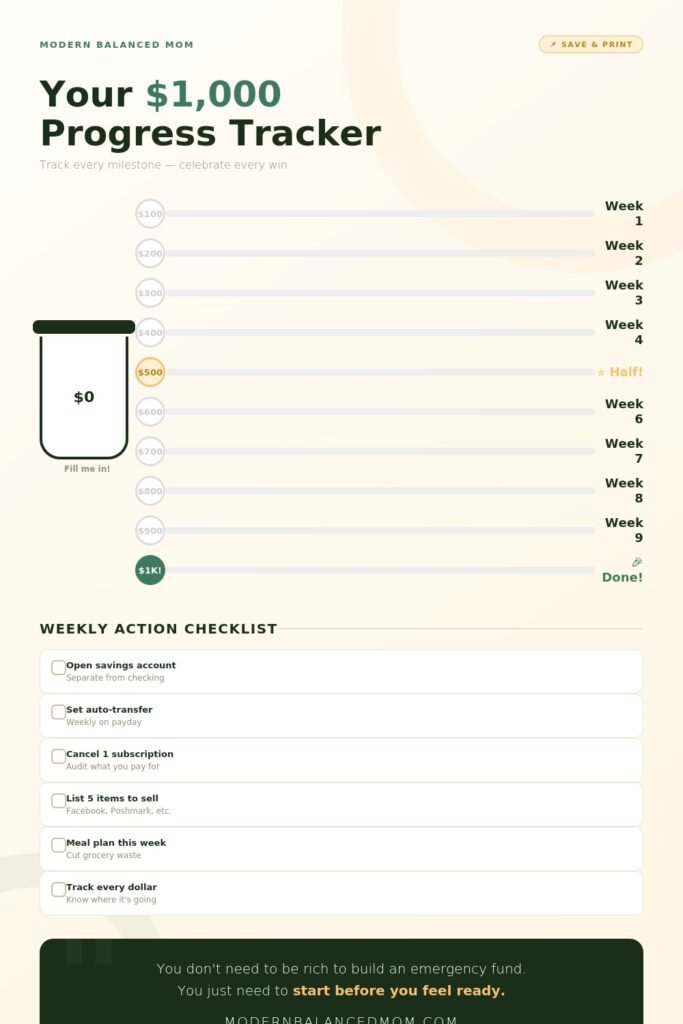
Action 4: Download and print your challenge tracker
Visual tracking is powerful.
Get a printable $1,000 challenge tracker (available at the end of this post) and put it somewhere visible—fridge, bathroom mirror, planner.
Every time you add money to savings, color in or check off the amount.
Seeing progress keeps you motivated when the journey feels long.

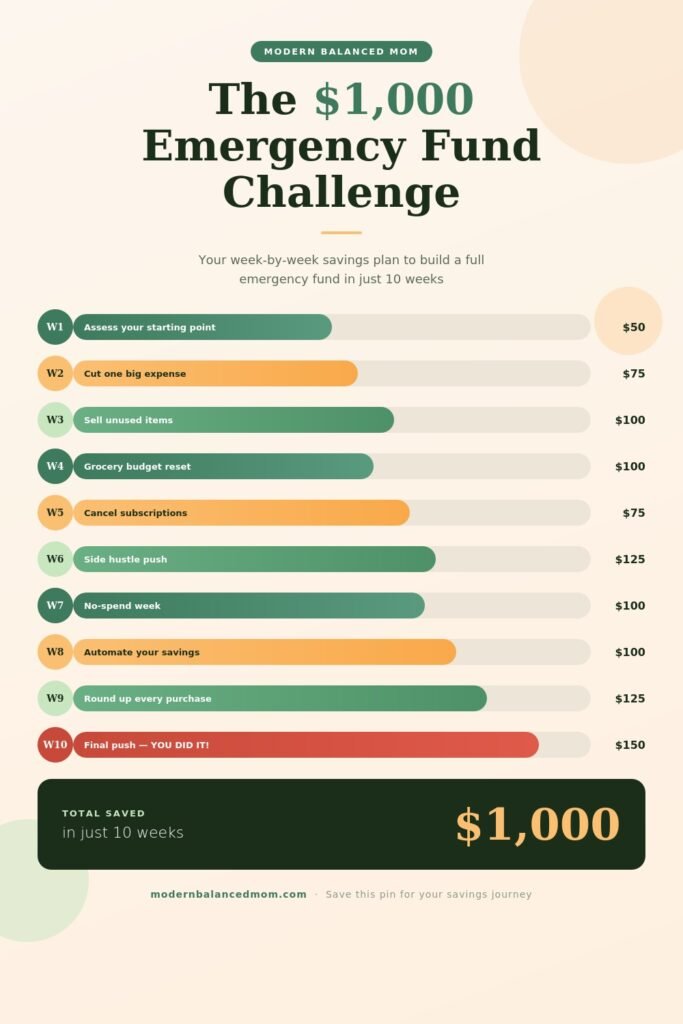
The 12-Week Action Plan
Here’s your week-by-week roadmap to $1,000. Each week includes specific actions and realistic savings goals.
Target: $83-85 per week (12 weeks to $1,000)
Some weeks you’ll save more, some less. The key is consistent progress.
Week 1: Find the Low-Hanging Fruit ($100 goal)
This week: Identify immediate cuts and quick wins
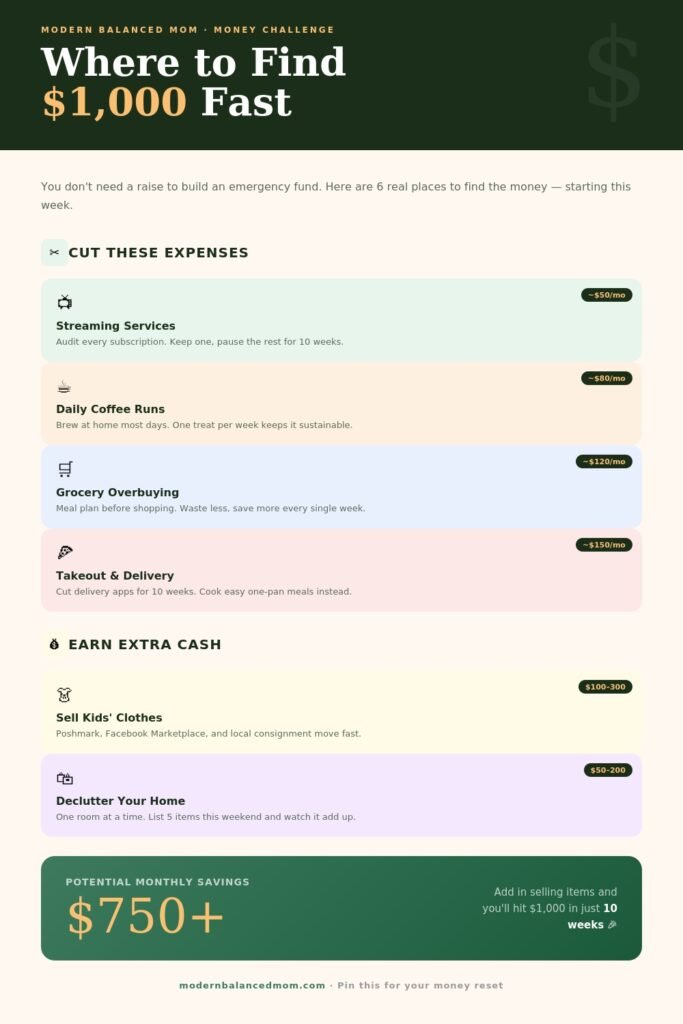
Action 1: Cancel unused subscriptions
Review your bank statements from the past month.
Look for:
- Streaming services you don’t watch
- Gym memberships you don’t use
- App subscriptions you forgot about
- Free trials that converted to paid
Average savings: $20-50/month
Action 2: Skip all eating out this week
Every coffee shop visit, lunch out, or dinner delivery = money to savings instead
Pack lunches. Make coffee at home. Cook simple dinners.
Average savings: $40-80 this week
Action 3: Sell something you don’t need
Look around your home:
- Clothes with tags still on
- Kids’ toys they’ve outgrown
- Electronics you don’t use
- Books, DVDs, games
Sell on:
- Facebook Marketplace (fastest)
- Poshmark (clothes)
- Decluttr (electronics, books)
- OfferUp (local pickup)
Average earnings: $30-100
Week 1 total saved: $90-230 (you’re already 9-23% there!)
Week 2: Trim Your Grocery Budget ($85 goal)
This week: Strategic grocery shopping
Action 1: Meal plan before shopping
Plan 5-6 simple dinners using:
- Ingredients you already have
- What’s on sale this week
- Budget-friendly proteins (chicken thighs, ground turkey, beans, eggs)
Action 2: Shop your pantry first
Before buying anything, use what you already own:
- That pasta in the back of the cupboard
- Frozen vegetables taking up freezer space
- Canned goods from six months ago
Action 3: Set a strict grocery budget
Challenge yourself: Cut your normal grocery spending by 25% this week
If you normally spend $150, aim for $110
Strategies:
- Buy store brand
- Skip convenience items (pre-cut veggies, pre-shredded cheese)
- No impulse purchases
- Stick to the list religiously
Average saved: $40-60 this week
Action 4: No-spend challenge
For the entire week, buy NOTHING except groceries and absolute necessities
No:
- Target runs “just to browse”
- Online shopping
- Coffee shops
- Convenience store stops
Average saved: $30-50
Week 2 total: $70-110 saved
Week 3: Bank a Windfall ($85 goal)
This week: Find money hiding in plain sight
Action 1: Collect and deposit all cash
Gather:
- Loose change throughout the house
- Cash in wallets, purses, coat pockets
- Coins in car cup holders
- Bills stuffed in drawers
Roll coins or use Coinstar (9% fee but instant), deposit everything
Average found: $20-50
Action 2: Return unused items
Look for:
- Items bought within return window (even without receipt, many stores give store credit)
- Gifts you won’t use
- Duplicate items
- Wrong sizes
Average returned: $25-75
Action 3: Pick up overtime or extra hours
If your job offers:
- Volunteer for overtime
- Pick up an extra shift
- Cover for a coworker
One extra shift or 4-5 overtime hours = $60-150 (after tax)
Action 4: Do a paid task or gig
Weekend side hustles:
- Babysit for a few hours
- Mow a neighbor’s lawn
- Clean someone’s house
- Run errands for elderly neighbors
Average earnings: $40-100
Week 3 total: $85-275 saved
Week 4: Cut Major Expenses ($85 goal)
This week: Negotiate and reduce bills
Action 1: Call your insurance company
Car and home insurance:
“I’m reviewing my budget and need to lower my insurance costs. What discounts am I eligible for? Can we adjust my coverage to reduce my premium?”
Common discounts:
- Bundling home and auto
- Paperless billing
- Pay-in-full discount
- Good driver discount
- Low mileage discount
Average savings: $20-60/month
Action 2: Review and reduce phone plan
Call your carrier or switch to a budget carrier:
Budget carriers (use major networks):
- Mint Mobile: $15-30/month
- Cricket: $30-55/month
- Visible: $25-45/month
If you’re paying $70+/month, you can cut this to $30-40
Average savings: $30-40/month
Action 3: Contact utility companies
Many utilities offer:
- Budget billing (evens out high/low months)
- Low-income assistance programs
- Payment plans that free up immediate cash
Call and ask: “What programs do you have to help reduce my monthly bill?”
Action 4: Pause or downgrade services
Temporarily pause:
- Hulu/Netflix/streaming (watch free options for a month)
- Gym membership (work out at home temporarily)
- Subscription boxes
Week 4 savings: $70-140 this month (bank first month’s savings to emergency fund)
Week 5-6: Lifestyle Adjustments ($170 total goal)
These two weeks: Sustained behavior changes
Week 5 Actions:
1. Pack all meals and snacks
- No buying lunch at work
- No vending machine
- No coffee shops
- Savings: $40-60
2. Free entertainment only
- Library instead of bookstore
- Parks instead of paid activities
- Free community events
- Home movie nights
- Savings: $30-50
3. DIY personal care
- Skip salon, do home haircuts or stretch appointments
- DIY nails
- At-home hair color
- Savings: $40-80
Week 5 total: $70-130
Week 6 Actions:
1. Transportation savings
- Carpool to work if possible
- Combine errands to reduce gas
- Skip unnecessary trips
- Savings: $20-40
2. Energy reduction
- Unplug devices not in use
- Lower/raise thermostat 2-3 degrees
- Shorter showers
- Run dishwasher/laundry only when full
- Savings: $15-30
3. Sell more items
- Continue decluttering and selling
- Kids’ clothes they’ve outgrown
- Kitchen items you don’t use
- Earnings: $30-60
Week 6 total: $65-130
Combined Week 5-6 savings: $135-260
Week 7-8: Income Boost ($170 total goal)
These two weeks: Bring in extra money
Week 7 Actions:
1. Freelance your skills
What can you do for money?
- Graphic design (Fiverr, Upwork)
- Writing/editing (Contently, ProBlogger)
- Virtual assistant work (Belay, Time Etc)
- Tutoring (Tutor.com, Wyzant)
- Pet sitting (Rover)
Even 3-5 hours = $50-150
2. Participate in paid studies
Research studies pay $50-200:
- User testing (UserTesting.com)
- Focus groups (FindFocusGroups.com)
- Medical studies (ClinicalTrials.gov)
- Market research (ResearchAndMe.com)
3. Gig economy work
Weekend or evening gigs:
- DoorDash/Uber Eats delivery
- Instacart shopping
- Task Rabbit tasks
- Rover dog walking
Week 7 earnings: $80-150
Week 8 Actions:
1. Cash in rewards
Check:
- Credit card rewards points (redeem for cash)
- Grocery store reward points
- Pharmacy rewards
- Old gift cards
Average: $20-50
2. Seasonal work
Many retailers hire temporary help:
- Weekend shifts at retail
- Event staffing
- Seasonal warehouse work
One weekend = $120-200
3. Yard sale or bulk selling
Gather everything sellable, host:
- Garage sale (in-person)
- Facebook Marketplace bulk lot
- Consignment shop drop-off
Average: $50-150
Week 8 earnings: $90-200
Combined Week 7-8 income: $170-350
Week 9-10: Deep Budget Cuts ($170 total goal)
These two weeks: Extreme frugality challenge
Week 9: Pantry Challenge
Goal: Spend $0 on groceries, eat only what you have
Rules:
- Use everything in pantry, fridge, freezer
- Get creative with combinations
- Only buy milk/bread if absolutely necessary
Savings: $80-150 (your normal grocery budget)
Week 10: No-spend week
Absolutely zero spending except:
- Bills already due
- Gas to get to work (only)
- Medications
Everything else = $0 spent
Strategies:
- Use up all leftovers
- Free entertainment only
- Avoid stores completely
- Unsubscribe from promotional emails
Savings: $50-100
Combined Week 9-10 savings: $130-250
Week 11-12: Final Push ($170 total goal)
These two weeks: Finish strong
Week 11 Actions:
Calculate your gap:
Where are you right now? How much more do you need to hit $1,000?
Deploy aggressive tactics:
1. Ask for help
- Take on extra work projects for bonuses
- Ask family for early birthday money (if applicable)
- Sell higher-value items (electronics, furniture you don’t need)
2. Maximize earnings
- Work every possible extra hour
- Do multiple gig jobs in one weekend
- Sell anything not nailed down
Week 11 goal: $85-100
Week 12 Actions:
Final sprint:
1. Analyze progress
If you’re close (within $50-100):
- One final push (extra shift, sell one more item)
- Cut spending to absolute zero
If you’re further away:
- Don’t panic—adjust your timeline
- Keep going, even if it takes 2-3 more weeks
- Progress is progress
2. Deposit that final amount
3. Celebrate your achievement
Week 12 goal: $70-100
Combined Week 11-12 savings: $155-200

Staying Motivated Through the Challenge
Twelve weeks is a long time to maintain intense focus. Here’s how to stay on track.
Track Progress Visually
Use your printable tracker daily:
Every deposit to savings:
- Color in the corresponding amount
- Calculate new total
- Write the date
Seeing the total climb keeps you going when motivation wanes.
Share Your Journey
Tell someone about your challenge:
Options:
- Accountability partner doing it with you
- Supportive friend who checks in weekly
- Online community (Facebook groups, Reddit)
- Social media updates (if you’re comfortable)
When others know, you’re less likely to quit.
Plan Mini-Celebrations
Hit milestones, celebrate (free/cheap ways):
$250: Family movie night at home
$500: Special home-cooked meal
$750: Day at a free local attraction
$1,000: Small celebration (within budget!)
Acknowledge progress without derailing it.
Remember Your “Why”
When tempted to quit or spend, revisit why this matters:
Your why might be:
- Never putting emergencies on credit cards again
- Sleeping at night without financial anxiety
- Having options when life happens
- Setting an example for your kids
- Breaking the paycheck-to-paycheck cycle
Write your “why” on your tracker. Read it when you’re struggling.
Adjust, Don’t Abandon
Some weeks you won’t hit the $85 target. That’s okay.
Life happens:
- Kids get sick
- Work is slower
- Unexpected expenses arise (ironic, right?)
If you have a low week:
- Don’t quit
- Adjust the timeline (add 1-2 weeks)
- Keep going
Saving $1,000 in 14 weeks instead of 12 is still a massive win.
What Counts as an Emergency (And What Doesn’t)
Now that you have $1,000 saved, you need clear rules about when to use it.
True Emergencies
Use your emergency fund for:
✓ Unexpected medical expenses (ER, urgent care, necessary prescriptions)
✓ Essential car repairs (you can’t get to work without it)
✓ Job loss (immediate needs while finding new work)
✓ Broken essential appliances (refrigerator, washer, heat/AC in extreme temps)
✓ Urgent home repairs (burst pipe, electrical failure, roof leak)
✓ Emergency pet care (life-threatening situation)
NOT Emergencies
Don’t use your emergency fund for:
✗ Holiday shopping
✗ Vacation
✗ Sale on something you want
✗ Upgrading functional items
✗ Non-essential cosmetic repairs
✗ Planned expenses you could have budgeted for
The Replacement Rule
If you do use emergency funds, immediately commit to replacing them.
Used $400 for car repair?
- Start a mini-challenge to rebuild that $400
- Same strategies, condensed timeline
- Goal: Back to $1,000 within 4-6 weeks
Your emergency fund should always replenish itself.
After You Hit $1,000: What’s Next?
Congratulations—you’ve saved $1,000! This is a massive achievement. But it’s not the finish line.
The Financial Journey Continues
Your next goals, in order:
1. Pay off high-interest debt (credit cards over 15% interest)
While keeping your $1,000 emergency fund intact, attack debt aggressively.
2. Build to 3-6 months of expenses
Once debt is gone, grow your emergency fund to cover 3-6 months of living expenses.
For a family spending $3,000/month:
- 3 months = $9,000
- 6 months = $18,000
This becomes your full emergency fund.
3. Save for specific goals
With debt gone and full emergency fund built:
- Down payment for house
- Kids’ college
- Retirement investing
- Vacation fund
The $1,000 emergency fund is your foundation. Everything else builds from here.
Don’t Stop the Habits
The behaviors that got you to $1,000 are the same behaviors that build wealth long-term:
✓ Intentional spending
✓ Saying no to unnecessary purchases
✓ Finding creative income sources
✓ Budgeting before spending
✓ Tracking progress
Keep these habits even after the challenge ends.
Common Challenges and Solutions
Let’s troubleshoot obstacles you’ll face.
Challenge #1: “I can’t find $85 per week”
Solution: Start smaller
Can’t find $85/week? Find what you CAN save:
- $50/week = $1,000 in 20 weeks (5 months)
- $30/week = $1,000 in 34 weeks (8 months)
- $20/week = $1,000 in 50 weeks (1 year)
Any progress toward $1,000 beats staying at $0.
Challenge #2: “An emergency happened during the challenge”
Solution: Handle it, then restart
If you have $400 saved and a $300 emergency hits:
- Use the $400 (that’s what it’s for)
- You now have $100
- Restart challenge from $100, not $0
You’re still ahead of where you started.
Challenge #3: “My partner isn’t on board”
Solution: Do it anyway
Ideal scenario: Partner joins you
Reality: You might be doing this alone
If your partner won’t participate:
- Save your portion of discretionary money
- Bank any windfalls that come to you
- Lead by example
When they see your $1,000, they might get inspired.
Challenge #4: “I’m a single parent with no margin”
This is the hardest situation and deserves acknowledgment.
Solutions:
- Extend timeline (18-24 weeks instead of 12)
- Focus on income side (side gigs, selling items)
- Utilize community resources (food banks, assistance programs) temporarily to free up cash
- Start with $500 as first goal, then build to $1,000
Even $25 saved per week = $1,000 in one year. It’s slower, but it’s still progress.
Your $1,000 Challenge Starts Now
You have everything you need:
✓ Week-by-week action plan
✓ Specific strategies for finding money
✓ Motivation techniques to stay on track
✓ Solutions to common obstacles
✓ Clear definition of true emergencies
The only thing left is to start.
Not next month when you “have more money.”
Not after the holidays.
Not when things are “less tight.”
Today. Right now.
Here’s what to do in the next 60 minutes:
- Open a separate savings account (online takes 10 minutes)
- Download and print your challenge tracker (link below)
- Find your first $20-50 (sell something, cancel a subscription, collect cash around the house)
- Deposit it immediately
- Mark it on your tracker
You’re officially $20-50 closer to your goal.
By this time next week, you could have $100 saved.
In 12 weeks, you could have $1,000.
In 6 months, you could have a full emergency fund.
It starts today.
Get Your Free $1,000 Challenge Tracker
Visual tracking makes this challenge achievable.
I’ve created a free printable $1,000 emergency fund challenge tracker to keep you motivated every single week.
What’s included:
✓ Weekly savings tracker with space to record each deposit
✓ Progress bar to color in as you save
✓ Milestone celebrations at $250, $500, $750, and $1,000
✓ Motivation prompts for difficult weeks
✓ Emergency definition checklist to keep you honest
✓ Weekly action items for all 12 weeks
Download it now, print it out, and put it somewhere visible.
Every time you add money to savings, mark it on the tracker. Watching that progress bar fill in creates momentum and accountability.
[DOWNLOAD FREE $1,000 CHALLENGE TRACKER]
This tracker has helped hundreds of moms save their first $1,000. Let it help you too.
The Life-Changing Power of $1,000
This isn’t just about money in a bank account.
Saving your first $1,000 emergency fund proves to yourself that:
✓ You CAN control your money
✓ You CAN delay gratification
✓ You CAN achieve hard financial goals
✓ You ARE capable of changing your family’s financial future
When the next emergency hits—and it will—you’ll have options instead of panic.
You’ll have security instead of stress.
You’ll have choices instead of being trapped.
That $1,000 emergency fund is your financial freedom fund.
It’s the foundation of every other financial goal you’ll ever achieve.
Start building it today.
Your future self is already thanking you.
Ready to save your first $1,000? Download the free challenge tracker, choose your Week 1 actions, and deposit your first $20-50 today. Share your starting point in the comments—we’re all cheering you on! You’ve got this.